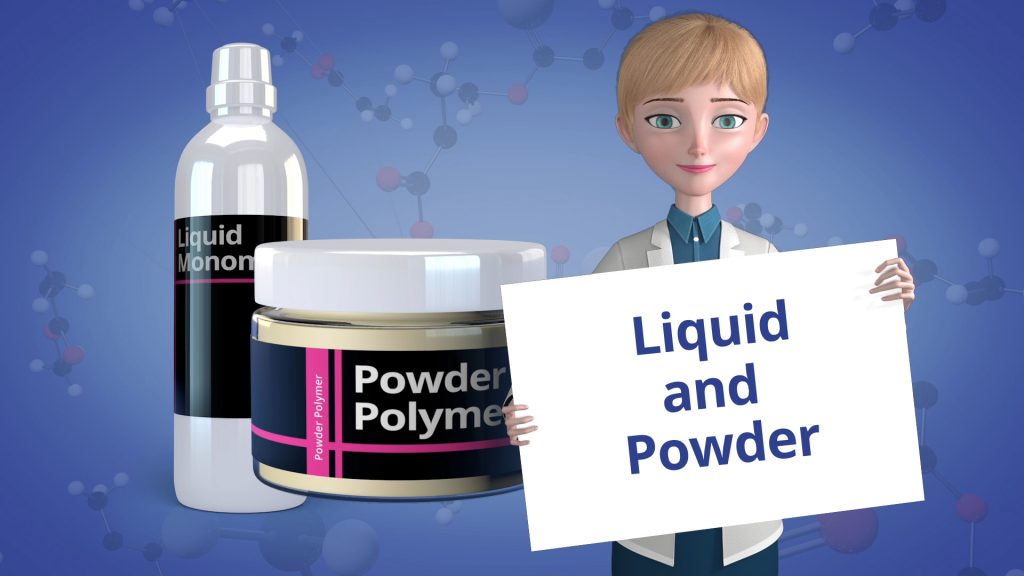
El monómero líquido y el polímero en polvo son un sistema de dos partes. La parte líquida contiene una mezcla de monómeros y un catalizador, mientras que la parte en polvo contiene perlas de polímero recubiertas de un iniciador, a menudo con un pigmento de color.


¿Qué hay en el sistema L&P?
Monómero líquido
Monómero significa unidades individuales de una molécula y el monómero líquido está lleno de estas unidades individuales de moléculas acrílicas. Cuando se exponen a un iniciador y energía térmica, estas formarán largas cadenas poliméricas. El monómero más común en L&P se llama etil metacrilato (EMA), un monómero acrílico sofisticado y otros aditivos específicos para controlar el proceso de polimerización, mejorar el rendimiento, la durabilidad y la vida útil del producto final.
Cuando se combina con el polvo polimérico y se expone a energía térmica (del aire alrededor de la uña o a través de la placa de la uña), comienza el proceso de polimerización L&P, ya que los iniciadores térmicos dentro del polvo polimérico se encuentran con los monómeros y los hacen unirse para crear largas cadenas poliméricas enredadas que incrustan las perlas de polímero dentro de un recubrimiento sólido para uñas.
La remoción se realiza sumergiendo en acetona.
Polvo de polímero
Esta parte del sistema consta de millones de pequeñas cuentas de acrílicos polimerizados. Cada cuenta actúa como portador de ingredientes importantes, incluidos los iniciadores térmicos sensibles al calor, típicamente peróxido de benzoilo (BPO). Estas cuentas de polímero proporcionan resistencia adicional dentro del recubrimiento de uñas y ayudan a proporcionar estructura dentro del recubrimiento.
Precauciones y problemas con L&P
Las reacciones alérgicas son un problema principal con el sistema L&P, debido a los alérgenos contenidos en el líquido monómero. Debe manejarse con cuidado y debe evitarse cualquier contacto con la piel. Se debe tener cuidado para lograr siempre un curado adecuado o de lo contrario el cliente estará expuesto a los alérgenos durante la eliminación.
Un aspecto importante del uso del sistema L&P es la proporción de mezcla, es decir, la cantidad de monómero líquido en relación con el polvo polimérico que se utiliza. Demasiado o muy poco polvo polimérico, o demasiado o muy poco monómero líquido, pueden crear un recubrimiento de uñas demasiado débil o demasiado quebradizo.
Existe otro tipo de monómero líquido utilizado en algunos salones económicos, y este es el MMA. Desafortunadamente, este tiene una adhesión terrible a la uña y la placa ungueal debe ser grabada profundamente para crear una superficie adecuada. El MMA es excesivamente fuerte y demasiado inflexible, lo que significa que puede romperse llevándose consigo la placa ungueal. También es más difícil de eliminar. El EMA, aunque más caro que el MMA, es la mejor opción a largo plazo con menos posibilidades de perder una clienta debido al daño infligido a sus uñas.